The Proof Is in the Glow: Before and After Red Light Results
Does Red Light Therapy Actually Work? Here's What the Evidence Shows
Red light therapy face before and after results are real — and the clinical data backs it up. Here's a quick summary of what you can expect:
| Concern | Improvement | Timeframe |
|---|---|---|
| Crow's feet wrinkles | Up to 38.3% depth reduction | 12 weeks |
| Dermal density | Up to 47.7% increase | 12 weeks |
| Pore size | Up to 32.8% reduction | 12 weeks |
| Inflammatory acne | Up to 77% fewer lesions | 12 weeks |
| Skin glow and tone | Visible improvement | 1-3 sessions |
| Fine lines and texture | Noticeable softening | 4-8 weeks |
These aren't marketing claims. They come from peer-reviewed clinical research using measurable skin metrics.
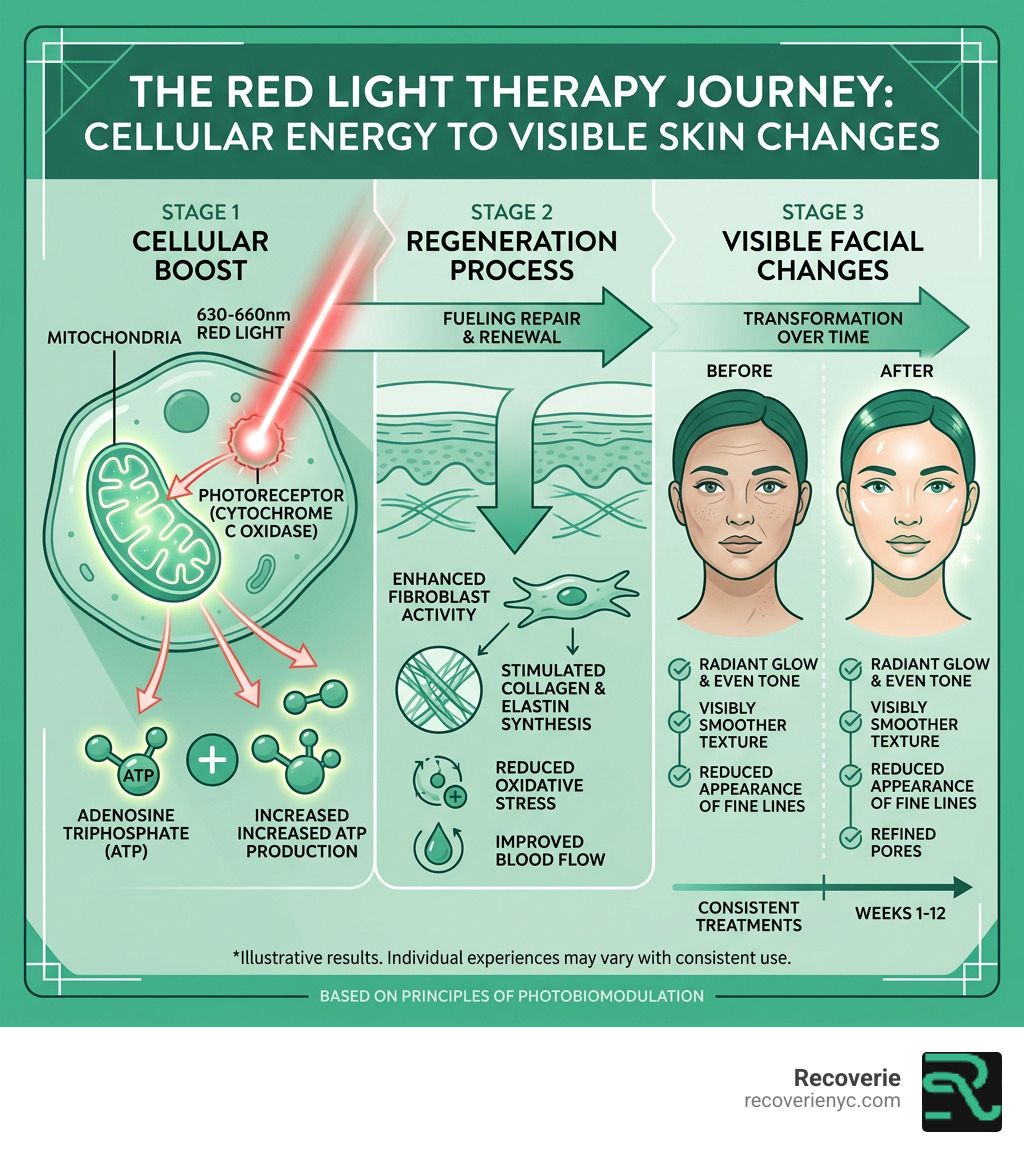
Red light therapy works by delivering specific wavelengths of light — typically 630–660nm — deep into your skin cells. Your mitochondria absorb this energy and use it to repair, regenerate, and rebuild. No heat. No damage. No downtime.
It started with NASA. Scientists studying plant growth in space discovered that red light accelerated cell repair in astronauts too. Dermatologists caught on, and now this technology is available both in clinics and at home.
For busy people dealing with stress, fatigue, and skin that shows it — this is one of the few non-invasive treatments with a genuine, measurable track record.
I'm Mellisa Kerchief, a board-certified Family Nurse Practitioner and founder of Novare Med Spa, where I've seen how consistent red light therapy face before and after protocols deliver real, lasting skin transformations. My background in emergency and critical care medicine means I approach every treatment through a patient safety and clinical evidence lens — which is exactly the standard I'll apply throughout this guide.
How Red Light Therapy Transforms Your Face
To understand why red light therapy face before and after photos look so dramatic, we have to go "geeky" for a moment and look at the cellular level. Every cell in our body contains mitochondria—think of these as microscopic power plants. These power plants produce a molecule called Adenosine Triphosphate (ATP), which is the literal fuel for cellular life.
When we expose our skin to specific wavelengths of red and near-infrared light, a photoreceptor within the mitochondria called cytochrome c oxidase absorbs the light photons. This triggers a biological response known as photobiomodulation. According to scientific research on visible light and cutaneous effects, this process reduces oxidative stress and kicks ATP production into high gear.
But the magic doesn't stop at energy. Red light therapy also:
- Increases Nitric Oxide: This helps dilate blood vessels, improving circulation and ensuring your skin cells receive a fresh flood of oxygen and nutrients.
- Stimulates Fibroblasts: These are the cells responsible for manufacturing collagen and elastin. By waking them up, the therapy naturally fills in fine lines and firms sagging skin.
- Reduces Inflammation: It calms the "fire" in the skin, which is why it’s so effective for redness and sensitive conditions.
For a deeper dive into these biological shifts, you can read more about how red light transforms your skin on our blog.
Real Results: Red Light Therapy Face Before and After Expectations
When New Yorkers visit us in Brooklyn or NYC, they want to know exactly what they’ll see in the mirror. While everyone's skin is unique, clinical studies give us a very clear picture of the average red light therapy face before and after transformation.
Research indicates that consistent 10-minute treatments over 8 weeks can reduce wrinkles by 30% and improve skin plumpness by 57%. Furthermore, data shows a 32.8% reduction in pore diameter after 12 weeks of consistent use.
Anti-Aging and Wrinkle Reduction: Red Light Therapy Face Before and After Evidence
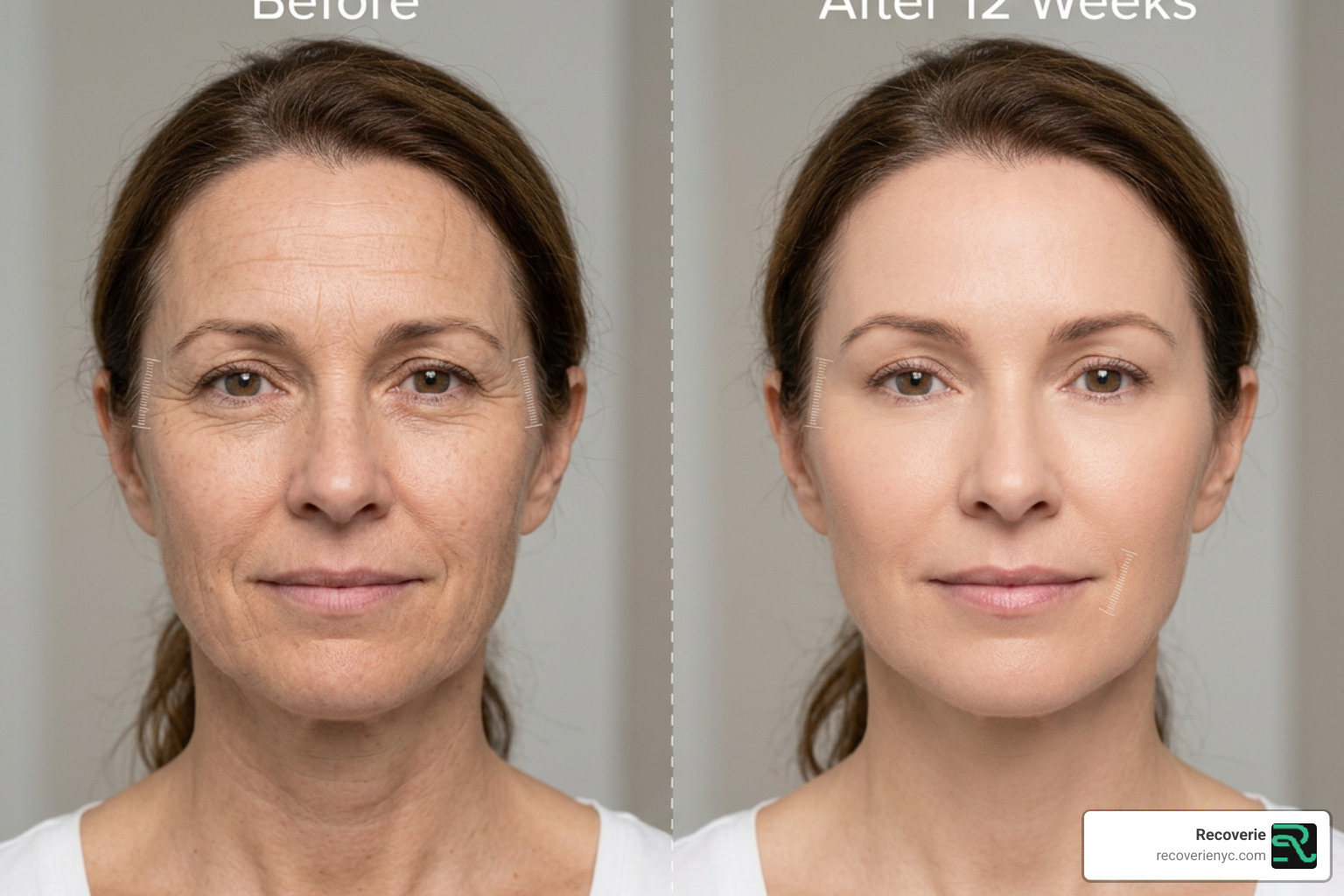
The quest for youthful skin often leads people to invasive procedures, but red light offers a natural alternative. Clinical measurements of "crow's feet" show a progressive improvement: a 15.6% decrease in wrinkle depth after just 28 days, which jumps to a staggering 38.3% after 84 days.
A landmark clinical study on collagen density and wrinkle reduction found that nearly every participant saw significant improvements in skin roughness and intradermal collagen density. This isn't just a surface-level "glow"—it’s a structural change. As dermal density increases (by up to 47.7% in three months), the sagging oval of the face appears more lifted and defined.
Acne and Scarring: Red Light Therapy Face Before and After Case Studies
If you’re struggling with breakouts, red light is a game-changer. It doesn't just treat the surface; it regulates the environment of your skin. Studies have shown a 77% reduction in inflammatory acne lesions and a 54% reduction in non-inflammatory lesions after 12 weeks.
For those dealing with oily skin, red light can decrease excess sebum (oil) by about 18% in just two weeks. Beyond active acne, the therapy is highly effective for healing. Research on LED therapy for post-surgical scarring concludes that red light is safe to use very soon after skin trauma to reduce fibrosis and improve the aesthetic outcome of scars. It also significantly calms rosacea flushing and persistent redness by soothing the vascular system.
The Science-Backed Timeline for Facial Rejuvenation
Patience is a virtue, especially in skincare. While some treatments offer a temporary "flash" result, red light therapy is about building long-term health. Here is the typical timeline we see at Recoverie:
- Weeks 1–2 (The Glow Phase): After just 1-3 sessions, most people notice improved hydration and a subtle radiance. This is due to increased circulation and immediate reduction in surface inflammation.
- Weeks 4–6 (The Texture Phase): You’ll start to see smoother skin. Rough patches begin to soften, and acne lesions heal significantly faster. Pore diameter usually begins its visible decrease during this window.
- Weeks 8–12 (The Structural Phase): This is where the "before and after" photos become truly striking. Collagen production has reached a point where fine lines are visibly filled, and the skin feels firmer to the touch.
One fascinating aspect of this therapy is the Arndt-Schulz Law. This principle suggests there is an "optimal dose" for light therapy. Too little does nothing, but too much can actually be counterproductive (bioinhibition). This is why we recommend specific session lengths rather than "the longer, the better" approach. The best part? The results are persistent. Studies show that skin improvements can be maintained for up to 28 days even after stopping treatment.
Maximizing Your Results: Professional vs. At-Home Devices
With the explosion of LED masks on social media, you might wonder if you should just buy a mask or visit a professional studio. The difference usually comes down to three things: Irradiance, Wavelength, and Power Density.
Professional-grade panels, like those we use at Recoverie, typically offer much higher irradiance (the intensity of the light hitting your skin) than battery-powered home masks. This allows the light to penetrate deeper into the tissue in a shorter amount of time. Effective treatments rely on precise wavelengths:
- 630nm – 660nm (Red): Ideal for surface rejuvenation and anti-aging.
- 830nm – 850nm (Near-Infrared): Reaches deeper tissues for cellular repair and inflammation.
To maximize your red light therapy face before and after results, preparation is key. Always start with clean, makeup-free skin. Interestingly, combining red light with antioxidants can create a synergistic effect. Ingredients like Green Rooibos or Hyaluronic acid can enhance light absorption and boost the plumping effects of the session.
If you’re ready to experience high-output, medical-grade technology, we invite you to explore our professional red light therapy services at our Brooklyn Heights location.
Frequently Asked Questions about Red Light Therapy Face Before and After
How often should I use red light therapy for my face?
For optimal results, consistency is more important than duration. Most clinical studies utilize a frequency of 3 to 5 times per week. At home, sessions are typically 10-20 minutes. If you are coming into Recoverie for professional sessions, 1-2 times a week is often sufficient due to the higher power of our equipment. Remember the Arndt-Schulz law: more is not always better!
Can I use red light therapy with retinol or vitamin C?
Yes, but timing matters. Some active ingredients like retinol can make the skin more photosensitive. We recommend using your red light device on clean skin before applying your evening serums. If you use Vitamin C in the morning, wait until after your red light session to apply it to avoid any potential irritation. Always follow up with a good moisturizer to lock in the hydration that the increased circulation brings to the surface.
Are there any side effects or safety concerns?
Red light therapy is non-thermal (it doesn't burn) and non-ablative. It is widely considered safe for all skin types. However, because the LEDs are very bright, we always provide protective goggles to shield your eyes during treatment. There is zero downtime—you can walk out of our Bridge Park Dr location and straight into your next meeting with nothing but a healthy glow.
Conclusion
The evidence is clear: red light therapy face before and after results are the product of real biology, not just beauty trends. By harnessing the power of photobiomodulation, we can help our skin cells return to their most energetic, youthful state. Whether you are looking to soften decades of sun damage, clear persistent acne, or simply maintain your "Brooklyn glow," red light therapy offers a science-backed, non-invasive path to radiance.
At Recoverie, we pride ourselves on being a community-focused sanctuary for New Yorkers. We combine advanced technology with a holistic approach to wellness. Ready to start your own transformation? Book your red light therapy session at Recoverie today and see the proof for yourself.